
WhatsApp Admin Liability: Legal Risks in Morocco 2026
WhatsApp Admin Liability: Legal Risks in Morocco 2026
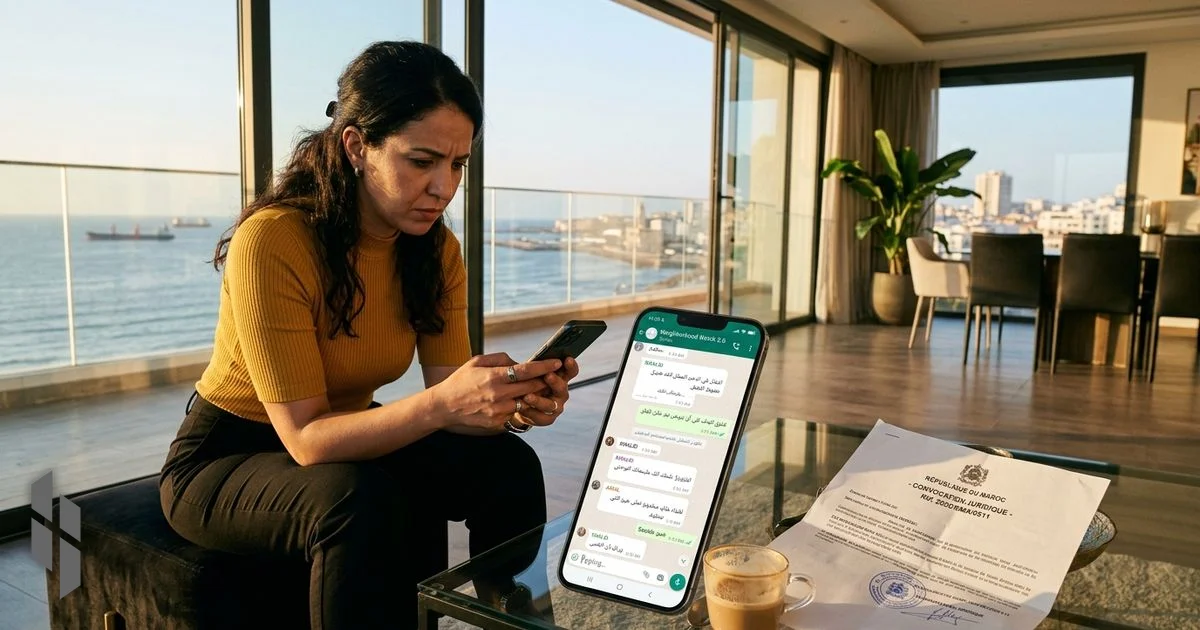
Imagine waking up to a notification that you have been summoned by the Brigade Nationale de la Police Judiciaire (BNPJ). You haven't posted anything illegal, you haven't shared "fake news," and you haven't insulted anyone. However, you are the creator and administrator of a neighborhood WhatsApp group with 200 members. Last night, while you were asleep, a member posted defamatory content about a local official or shared private photos of a neighbor without consent.
In the legal landscape of Morocco in 2026, the question is no longer just "who posted it?" but "who allowed it to stay?" As digital communication becomes the backbone of Moroccan social and professional life, the role of a WhatsApp group admin has shifted from a casual social convenor to a position of significant legal responsibility.
This comprehensive guide explores the intricate web of Moroccan laws—from the Penal Code to the Press and Edition Code—to determine exactly where your liability begins and ends as a WhatsApp admin in the Kingdom.
Legal Foundation: The Statutes Governing Digital Spaces
To understand the risks in 2026, we must look at the bedrock of Moroccan digital legislation. Unlike some jurisdictions that have specific "WhatsApp Laws," Morocco utilizes a combination of the Penal Code, privacy laws, and telecommunications regulations to hold individuals accountable for digital content.
1. The Moroccan Penal Code (Law 05-03 and Article 447)
The primary source of risk for any digital user in Morocco is Article 447-1 and its subsequent sections. These articles were introduced to combat the "revenge porn" and privacy violations that plagued social media.
- Article 447-1: Criminalises the intentional recording, filming, or transmitting of private conversations or pictures without the consent of the individuals involved.
- Article 447-2: Targets the distribution of false allegations or facts with the intent to harm a person's private life or defame them.
As an admin, if you knowingly allow such content to remain on your platform, you may be viewed as an accomplice under the general principles of criminal participation defined in Article 129 of the Penal Code.
2. Law 09-08: Protection of Personal Data
Administering a group involves handling the phone numbers and identities of members. Under Law 09-08, the collection and processing of personal data require consent. While casual groups are often exempt from the heavy industrial requirements of the CNDP (Commission Nationale de contrôle de la protection des Données à caractère Personnel), professional or commercial WhatsApp groups must strictly adhere to data protection standards.
3. Law 88-13: The Press and Edition Code
A critical debate in Moroccan courts in 2026 is whether a large WhatsApp group (especially those with hundreds of members) constitutes a "public" space. If a group is deemed public, the admin may be held to the standards of a "Director of Publication" under Law 88-13. This law imposes a duty of "proactive moderation" to prevent the spread of content that incites violence, harms the territorial integrity of the Kingdom, or insults the Monarchy.
4. Law 24-96: Telecommunications Regulation
As seen in Reference 2 and Reference 8 of the Moroccan regulatory framework, entities providing communication services (like ORBCOMM Maghreb or Gulfsat Maghreb) are held strictly liable for the "good functioning of their networks" and "respect for legislative provisions." While a WhatsApp admin is not a telecommunications carrier, the judicial trend in Morocco is moving toward holding "digital gatekeepers" to a higher standard of care regarding the content flowing through their "mini-networks."
5. Law 31-13: Right to Access Information
In groups where public service information is shared, admins must ensure that the dissemination of information does not violate the provisions of Law 31-13, particularly regarding the confidentiality of state secrets or sensitive administrative data.
Practical Guide: Procedures, Timelines, and Costs
If you find yourself facing legal scrutiny or if you wish to take action against a group admin, the Moroccan legal system follows a specific procedural path.
Step-by-Step Procedure for Filing a Complaint
If illegal content is posted in a group you manage, or if you are a victim of such content, follow these steps:
- Evidence Preservation: Do not simply delete the message. Use the "Export Chat" feature to save a copy with timestamps.
- Bailiff Verification (Huissier de Justice): To make digital evidence admissible in a Moroccan court, you should hire a Huissier. They will view the WhatsApp group on your phone and draft a Procès-Verbal (PV). This document officially records the existence of the message and the admin's reaction (or lack thereof).
- The e-Blagh Platform: For immediate reporting of cybercrime, the Moroccan DGSN provides the e-Blagh portal. This is an administrative step that can trigger a police investigation.
- Filing with the Public Prosecutor (Procureur du Roi): A formal criminal complaint is filed at the Court of First Instance.
Timelines and Costs
- Statute of Limitations: For defamation under the Press Code, the window to act is very short (often 6 months). For general Penal Code violations, it is usually 5 years.
- Bailiff Fees: A standard PV for digital evidence typically costs between 500 MAD and 1,500 MAD, depending on the complexity and volume of the content.
- Legal Representation: While you can file a complaint yourself, hiring a lawyer is highly recommended for navigating the nuances of Criminal Justice and the Penal Code.
Required Documents
- A certified copy of your National ID (CNIE).
- The Bailiff’s PV.
- Screenshots (though these are secondary to the PV).
- The phone numbers and, if possible, the identities of the admin and the original poster.
Key Provisions Explained: When is an Admin Liable?
The core of the risk in 2026 lies in the concept of "Knowledge and Control." Moroccan courts generally apply the following logic:
The "Host" vs. "Editor" Distinction
Under the principles of Digital Media Regulation in Morocco, an admin is often treated as a "host" (hébergeur). A host is not liable for content they didn't write unless they were made aware of its illegal nature and failed to act promptly.
The Duty to Delete
With the 2026 updates to WhatsApp's interface, admins have the "Delete for Everyone" power. In Moroccan law, having the technical power to stop a crime and failing to do so can be interpreted as negligence or complicity. If a member posts a "fake news" item that causes public disorder, and the admin leaves it up for 24 hours despite being active in the group, the admin faces a high risk of being charged under Article 447-2.
Public vs. Private Groups
- Private/Family Groups: Courts are more lenient. The expectation of privacy is high, and the "public" harm is low.
- Public/Professional Groups: If the group link is shared on Facebook or LinkedIn, it is no longer a private conversation. It is a "public digital space," and the admin's liability mirrors that of a newspaper editor.
Specific Offenses to Watch
- Defamation (Diffamation): Attacking the honor of an individual.
- Contempt of Officials: Insulting public servants or institutions.
- Breach of Privacy: Sharing "leaked" documents or private photos.
- Terrorism Glorification: A zero-tolerance area under Moroccan law where admins can face severe prison sentences for failing to report such content.
Common Mistakes & How to Avoid Them
Many Moroccans fall into legal traps due to a lack of digital literacy regarding the law. Here are the most common pitfalls:
1. The "Disclaimer" Fallacy
Many admins post a message saying: "I am not responsible for the opinions expressed in this group." The Reality: In Moroccan law, you cannot contract out of criminal liability. A disclaimer does not override the Penal Code. If you allow a crime to happen on your platform, a disclaimer will not protect you from the BNPJ.
2. Being an "Inactive" Admin
If you create a group and then "mute" it for months, you are still the legal creator. If illegal activity occurs, your defense of "I didn't see it" may be viewed as criminal negligence. Solution: Always have at least two active admins. If you can no longer manage a group, leave it and appoint a successor, or delete the group entirely.
3. Adding People Without Consent
Under Law 09-08, adding someone to a group exposes their phone number to all other members. In a professional context, this can be a violation of data privacy. Always ask for permission or share a "Join Link" instead of adding people manually.
4. Failing to Set Group Rules
A group without a "Charter" or "Rules of Engagement" is a liability. Solution: Post a clear set of rules stating that hate speech, defamation, and unverified news are banned. If a member violates these, remove them immediately. This demonstrates "Good Faith" (Bonne foi) in court.
5. Sharing "Leaked" Official Documents
Morocco has strict laws regarding the confidentiality of administrative documents. If a member shares a leaked "Note de Service" or a confidential government PDF, the admin must delete it immediately to avoid being implicated in a breach of state security or Administrative Law violations.
Conclusion with Key Takeaways
As we navigate the digital landscape of 2026, the Moroccan judiciary is increasingly holding individuals accountable for their digital footprints and the "digital territories" they manage. Being a WhatsApp admin is no longer a "set it and forget it" task. It requires vigilance, a basic understanding of the Penal Code, and a proactive approach to moderation.
By following the guidelines of Law 05-03 and ensuring you act swiftly when illegal content appears, you can enjoy the benefits of digital community without the shadow of legal peril.
Summary of Key Actions:
- Monitor your groups regularly.
- Delete any content that violates Article 447 (Privacy) or involves defamation.
- Remove repeat offenders to show you are enforcing the law.
- Document your actions if you ever need to prove your "Good Faith" to the authorities.
Related Search Terms
9anoun ai, 9anon ai, kanon ai, kanoun ai, qanon ai, qanoun ai
Frequently Asked Questions
Yes, if the post involves terrorism, threats to national security, or severe privacy violations (Article 447), and the admin knowingly fails to remove it or reports it, they can be charged with complicity or negligence.
While screenshots are helpful, they are easily faked. For a strong legal case, a Bailiff (Huissier) must officially record the content directly from the app to create a legally binding Procès-Verbal.
You should immediately use the 'Delete for Everyone' feature, remove the offending member, and post a warning to the group. This demonstrates your compliance with Law 09-08 and Article 447-1.
Generally, Law 09-08 excludes data processing for purely personal or household activities. However, if the group is used for business or shared publicly, you must comply with data protection rules.
Moroccan law uses the standard of 'promptness.' While there is no fixed hour limit, failing to act within 24 hours of becoming aware of the content is often viewed as a failure of duty by the courts.
In a private or social context, no. However, in a professional or 'public' group, if the removal causes documented professional harm or is based on discrimination, it could theoretically lead to a civil claim, though this is rare.
Get weekly Moroccan legal updates 📬
Exclusive insights on Moroccan law, citizen rights, and new court decisions — delivered straight to your inbox.
No spam. Unsubscribe anytime.
Have More Legal Questions?
Consult 9anon AI now and get accurate, instant answers about your legal situation in seconds.
Related Articles
Employer Liability for Workplace Accidents - Morocco (2026)
What is the employer's liability in case of a workplace accident in Morocco? Know employee rights and legal procedures in 2026. Get legal guidance
Digital Media Regulation: New Press Law 2026 Morocco
Will the new press law impact digital content in 2026? Learn how online news and e-commerce reporting will be regulated in Morocco, and what are your consumer rights.
Digital Tax Registration: E-Commerce in Morocco 2026
Do you run an e-commerce site? Learn about TVA obligations and new digital tax registration under CGI 2026. Stay compliant now!