
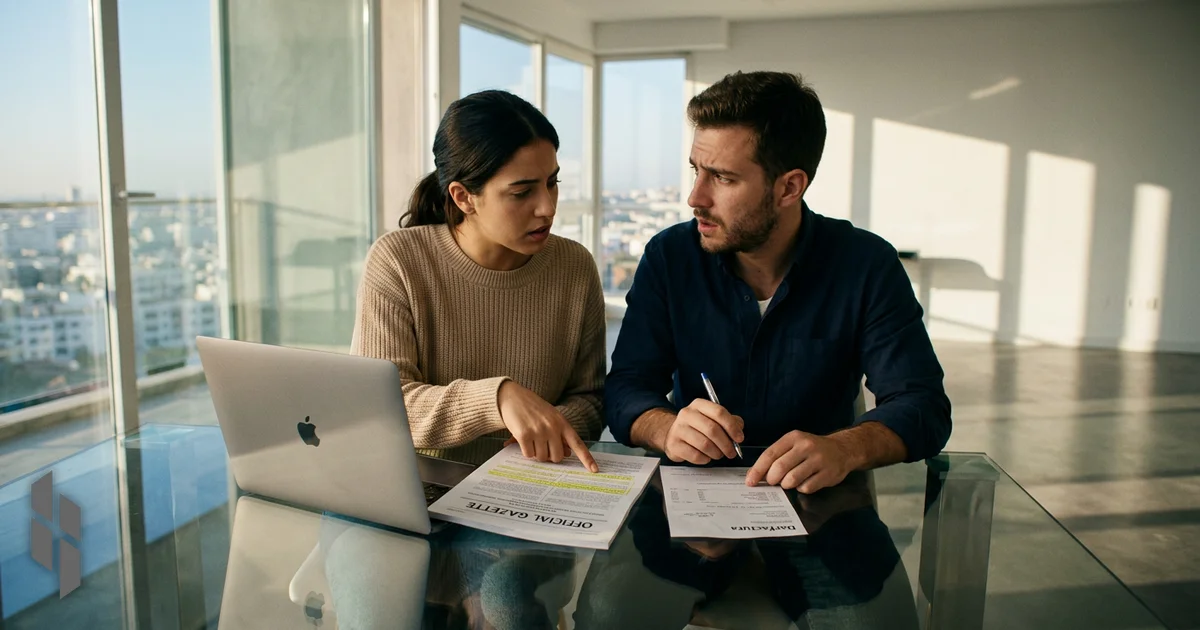
2% Surtax: Cash Property Purchases in Morocco (2026)
2% Surtax: Cash Property Purchases in Morocco (2026)
The landscape of real estate transactions in Morocco has undergone a seismic shift as we enter 2026. For decades, the "black money" or "under-the-table" cash payment culture was an open secret in the Moroccan property market. However, with the full implementation of the latest fiscal reforms and the Finance Law 50.25, the Moroccan government has introduced a decisive mechanism to enforce transparency: the 2% Surtax on Cash Property Purchases.
Imagine you are purchasing a luxury apartment in Casablanca or a traditional Riad in Marrakech. The agreed price is 2,000,000 MAD. In previous years, a buyer might have been tempted to pay a portion in cash to "lower" the registered price and save on registration duties. In 2026, this decision could cost you significantly more than the taxes you intended to avoid. Not only does the Direction Générale des Impôts (DGI) now utilize advanced AI cross-referencing to detect under-declaration, but any portion of the purchase price paid outside of documented bank circuits now triggers an automatic additional 2% levy.
In this comprehensive guide, we will explore the legal foundations of this surtax, the specific articles of the General Tax Code (CGI) that govern it, and the practical steps you must take to ensure your real estate investment remains compliant and cost-effective.
Legal Foundation: The War on Informality
The 2% surtax is not merely a revenue-generating measure; it is a structural tool designed to integrate the real estate sector into the formal banking system. This movement is supported by several key legislative pillars.
The Finance Law Framework
The primary authority for this measure stems from the Finance Law 50.25 (for the 2026 fiscal year), which builds upon the transparency initiatives first introduced in the 2024 and 2025 budget cycles. Historically, Article 65 of the General Tax Code (CGI), as referenced in [Reference 2] and [Reference 6], established the rules for determining "Net Profitable Real Estate Gain" (Profit Foncier). The 2026 reforms expand upon this by penalizing the method of payment itself, not just the capital gain.
Specific Articles and Codes
To understand the legality of the 2% surtax, one must look at the following legal instruments:
- Article 193 of the General Tax Code (CGI): This article governs the "Registration Duties" (Droits d’enregistrement). The standard rate for built property is 4%. The 2026 amendment adds a 2% "supplementary duty" for transactions where the payment is not justified by a bank-issued cheque, a bank transfer, or a regulated payment intermediary.
- Article 65 of the CGI: As seen in [Reference 2], this article defines how the taxable profit is calculated. By paying in cash, buyers often lose the ability to include those costs in their "acquisition price" for future resale, leading to massive tax hits later.
- Law No. 43-05 on Money Laundering: This law works in tandem with tax regulations. Notaries are now legally obligated under this framework to report any cash transactions exceeding a specific threshold (currently 10,000 MAD) to the National Financial Intelligence Authority (ANRF).
- Dahir No. 1-11-178 (The Real Estate Code / Law 39-08): This governs the rights in rem. While it focuses on ownership, its intersection with fiscal law ensures that a property title cannot be fully "cleared" at the Land Registry (Conservation Foncière) without a tax discharge (Quitus Fiscal) proving the 2% surtax was either paid or exempted via bank proof.
- Article 224 of the CGI: This article, mentioned in [Reference 2], deals with the valuation of real estate. It empowers the administration to disregard the "declared price" in a contract if it does not align with the "market value," especially when cash payments are suspected.
For more on how these laws interact with business operations, see our guide on Moroccan Commercial Law: Business Compliance.
Practical Guide: Navigating the 2026 Purchase Process
Buying property in Morocco in 2026 requires a "bank-first" mentality. If you fail to produce a paper trail for your funds, the Notary is legally prohibited from registering the transaction at the standard 4% rate.
Step-by-Step Procedure
1. The Preliminary Agreement (Compromis de Vente): Ensure that the contract explicitly states that the entire price will be paid via bank transfer or certified cheque. This protects the buyer from sellers who might demand "black" cash at the last minute.
2. The Notary’s Escrow Account: Under Moroccan law, funds should never be handed directly to the seller. They must be deposited into the Notary's account at the Caisse de Dépôt et de Gestion (CDG).
- Required Document: A "Bordereau de versement" (deposit slip) or a swift confirmation of the transfer.
- Timeline: Funds should be cleared 48 hours before the signing of the final deed.
3. The Declaration of Payment Method: In the final deed of sale, the Notary must insert a clause specifying the payment method. Under the 2026 regulations, the Notary must attach a copy of the bank instrument to the electronic filing sent to the DGI.
4. Payment of Duties:
- Standard Registration: 4% of the property value.
- Land Registry Fee: 1.5% + 100 MAD (Fixed fee).
- The Cash Surtax: If you paid any portion in cash, the Notary will calculate an additional 2% on that specific portion.
Required Documentation for Exemption
To avoid the 2% surtax, you must provide:
- A certified bank cheque (Chèque de banque).
- A bank transfer confirmation (Avis de virement).
- For foreigners: A "Formule de Change" proving the importation of foreign currency through a Moroccan bank account.
Costs and Timelines
The registration process must be completed within 30 days of signing the deed. If the 2% surtax is triggered due to cash payment, it must be paid at the same time as the 4% registration duty. Failure to do so results in late payment penalties (15% for the first month, plus 0.5% for each subsequent month).
Key Provisions Explained
The 2% surtax is part of a broader "Digital Morocco" initiative. As highlighted in [Reference 1] and [Reference 7], the Ministry of Justice and the Tax Authority have moved toward an "Electronic Court" and digital tax filing system. This means that "manual" errors are no longer a defense.
The "Transparency" Threshold
While the law technically applies to any cash, the Moroccan administration focuses heavily on transactions where the cash component exceeds 20,000 MAD. Below this, the surtax may not be triggered in small-scale residential repairs, but for property acquisition, the 2% is applied from the first Dirham if the payment is not bank-verified.
Impact on Social Housing
As noted in [Reference 3], real estate developers of social housing (units priced at 140,000 MAD or 250,000 MAD) are subject to specific exemptions. However, the buyer's side remains strict. Even in social housing, if a buyer pays a "supplement" in cash to the developer—a common but illegal practice—they are now liable for the 2% surtax plus potential fines for tax evasion.
The Role of the Notary
The Notary is no longer just a witness; they are a "tax collector" for the state. Under the Notary Code, they are personally liable if they register a deed at the 4% rate while knowing a cash payment took place. This has led to a much stricter vetting process in 2026.
Foreigners and Foreign Currency
Foreign investors must be particularly careful. According to [Reference 4], transactions involving foreign entities or individuals are under high scrutiny. To avoid the 2% surtax, a foreigner must prove the funds came from a "Convertible Dirham Account." If a foreigner brings physical cash into the country and pays a seller directly, they will not only pay the 2% surtax but may also face "Office des Changes" (Exchange Office) penalties for violating currency export-import laws. For more details, see Foreign Property Ownership 2026.
Common Mistakes & How to Avoid Them
Even seasoned investors fall into traps regarding the new 2026 fiscal environment. Here are the most common pitfalls:
1. Paying the "Reservation Fee" in Cash Many buyers pay a small deposit (e.g., 50,000 MAD) in cash to "hold" the property. In 2026, this 50,000 MAD will be hit with the 2% surtax because it cannot be traced through the Notary's CDG account.
- Solution: Always use a bank transfer for the reservation fee and ensure the Notary records it in the final deed.
2. Under-declaring the Price to "Help" the Seller A seller might ask you to declare 1,500,000 MAD on paper but pay 2,000,000 MAD total (500,000 in cash).
- The Risk: You save 4% on the 500,000 (20,000 MAD), but you pay a 2% surtax if caught (10,000 MAD). More importantly, when you sell the property in five years for 2,500,000 MAD, your "profit" will be calculated from 1,500,000 MAD instead of 2,000,000 MAD. You will pay a 20% Taxe sur le Profit Immobilier (TPI) on an extra 500,000 MAD of "fake" profit.
- Solution: Always declare the 100% real price.
3. Ignoring the "Droit de Préemption" If the DGI believes the price is too low (due to hidden cash), the State can exercise its "Right of Pre-emption," effectively buying the property from you at your declared (low) price plus 10%. You would lose your "black" cash entirely.
4. Forgetting the Tax Amnesty Rules If you have historically held "informal" cash, 2026 offers certain windows to regularize these funds. Check our article on Business Tax Amnesty Morocco 2026 to see if you can clean your capital before investing in real estate.
Conclusion with Key Takeaways
The introduction of the 2% surtax in 2026 marks the end of the "cash is king" era in Moroccan real estate. By aligning the General Tax Code with international anti-money laundering standards, Morocco has made it significantly more expensive to operate in the shadows. For the honest investor, this is a positive development that stabilizes market values and ensures that your "acquisition cost" is legally recognized for future tax deductions.
Summary of Key Takeaways:
- Standard Rate: Property registration is 4%, but cash payments trigger an additional 2% surtax.
- Traceability: Only bank transfers, certified cheques, or convertible Dirham account proofs exempt you from the surtax.
- Legal Basis: The surtax is rooted in Finance Law 50.25 and amendments to Article 193 of the CGI.
- Future Impact: Paying cash reduces your official acquisition price, leading to much higher capital gains tax (TPI) when you eventually sell.
- Notary Role: Notaries are now required to electronically report payment methods to the DGI via the mahakim.ma and tax portals.
Frequently Asked Questions
The standard rate is approximately 6% to 7% of the property value, which includes 4% registration duty, 1.5% land registry fee, and notary fees. However, if you pay in cash, an additional 2% surtax is applied, bringing the total closer to 8% or 9%.
It is highly discouraged. Any cash paid directly to the seller will be subject to the 2% surtax because it cannot be verified by the Notary's bank records. Always deposit funds into the Notary's CDG escrow account.
Yes. While social housing has lower base registration rates (often 3% or exempt for developers), the 2% surtax applies to any part of the transaction paid in cash by the buyer to ensure transparency in the sector.
The DGI now requires Notaries to attach proof of bank payment (cheque copy or transfer advice) to the electronic registration. Furthermore, the DGI uses AI to compare declared prices with market benchmarks in specific neighborhoods.
Laws are generally not retroactive. However, if the transaction is being registered in 2026, the new rules apply. If you are selling a property bought with 'black' cash years ago, you may face high capital gains tax because your official purchase price was under-declared.
The only way to avoid the 2% surtax is to provide a bank-certified instrument of payment. There are no exemptions based on the type of property or the status of the buyer if cash is the chosen medium of exchange.
Get weekly Moroccan legal updates 📬
Exclusive insights on Moroccan law, citizen rights, and new court decisions — delivered straight to your inbox.
No spam. Unsubscribe anytime.
Have a property or real estate question?
Consult 9anon AI now and get accurate, instant answers about your legal situation in seconds.
Related Articles
Real Estate & Family for MREs: Digitization 2026
Your guide as an MRE to obtaining online administrative and real estate documents, including building permits and custody papers in 2026.
Informal Sales & Property: Cassation Rulings 2026
Is an informal contract enough to transfer property ownership? Learn how recent Cassation Court rulings impact unregistered contract validity in 2026.
Digital Building Permit: A Step-by-Step Guide 2026
Applying for a building permit? Learn how to apply online in Morocco in 2026. A full guide with documents and steps to avoid delays.