
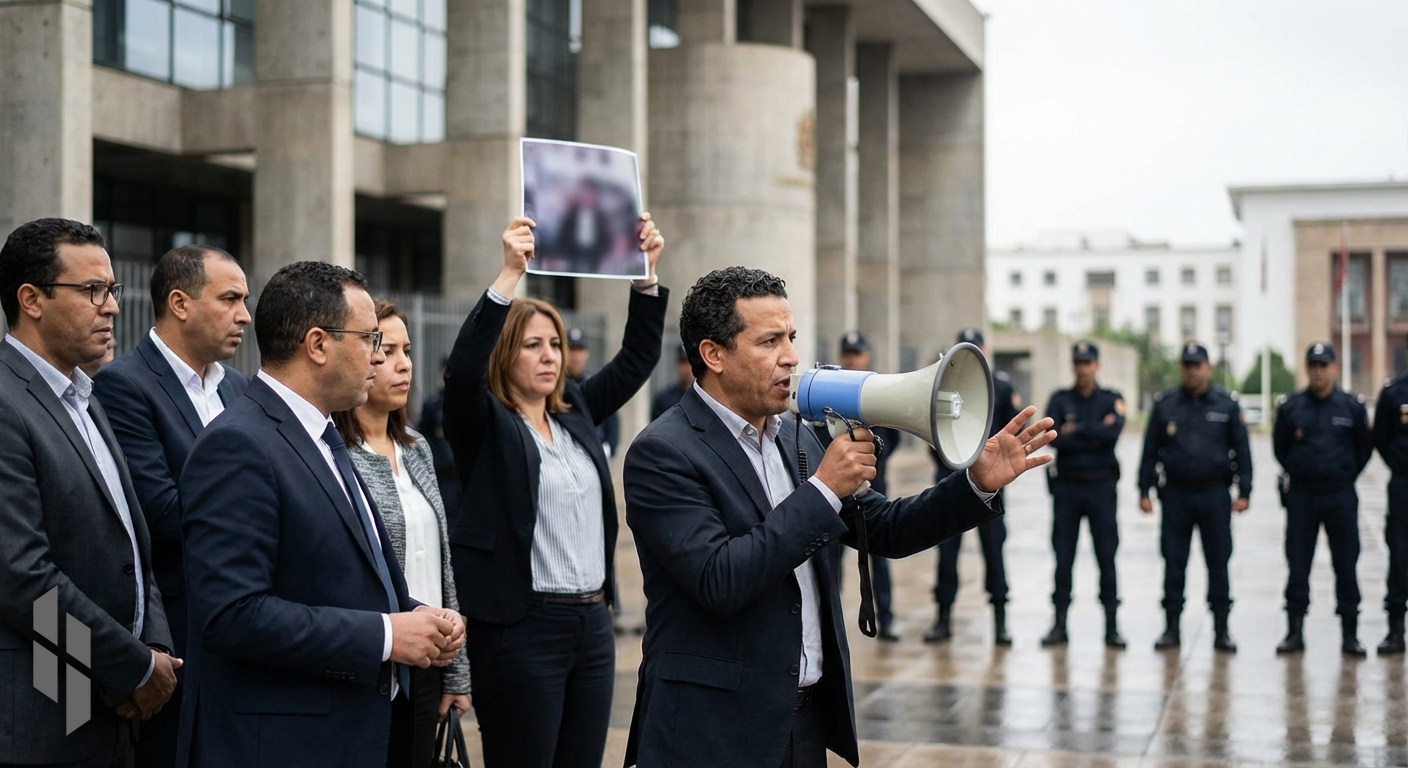
Lawyers' Protests Against Legal Profession Bill in Morocco
Lawyers' Protests Against Legal Profession Bill in Morocco
The legal landscape in Morocco is currently undergoing a period of significant transformation. Central to this evolution is the ambitious Charter for the Reform of the Judicial System, which seeks to modernize the judiciary, enhance the efficiency of the courts, and align domestic legislation with international standards. However, this path toward reform has not been without friction, particularly regarding the legislative frameworks governing the legal profession itself.
In recent years, Moroccan lawyers have engaged in various forms of protest and advocacy against proposed legislative changes. These tensions often center on the balance between state-of-the-art judicial efficiency and the traditional independence of the bar. Understanding these developments requires a look at the strategic performance projects of the Ministry of Justice and the evolving draft laws that aim to reshape how justice is administered in the Kingdom.
The Drive for Judicial Efficiency and Performance
The Moroccan Ministry of Justice has historically outlined its objectives through detailed Performance Efficiency Projects (Projets de Performance). According to Reference 1 and Reference 5, a primary goal of the Moroccan state is to increase "judicial efficiency" (Najaa). This involves several key pillars:
- Simplification of Procedures: Streamlining the Code of Civil Procedure and the Code of Criminal Procedure to reduce delays.
- Rationalisation of Appeals: Encouraging the finality of judgments in simple cases to prevent the backlog of higher courts.
- Digitalization and Notification: Improving the reliability of the notification (tabligh) and execution (tanfid) systems.
While these goals are objectively beneficial for the public, the legal profession often views the methods of implementation with caution. Lawyers argue that an over-emphasis on "speed" and "efficiency" must not come at the cost of the rights of the defense or the quality of judicial scrutiny.
Independence and the Proposed Legal Profession Bill
A major point of contention involves the draft laws intended to modify the profession of advocacy. Reference 8 mentions the ongoing efforts to refer a "Draft Law amending and supplementing the Law organizing the profession of lawyers" to the General Secretariat of the Government.
Moroccan lawyers emphasize that the independence of the legal profession is a cornerstone of a fair trial. Protests often arise when proposed bills are perceived to:
- Increase administrative oversight by the Ministry of Justice over the Bar Associations.
- Modify the entry requirements or the training structures for new lawyers.
- Alter the disciplinary procedures that govern professional misconduct.
The legal community argues that for a lawyer to effectively combat corruption and protect human rights, they must remain independent from the executive branch. This independence is not merely a professional privilege but a guarantee for the citizen that their representative can challenge state actions without fear of reprisal.
Anti-Corruption and Criminal Justice Reform
The reform movement in Morocco is also heavily focused on anti-corruption and the protection of fundamental liberties. Reference 4 and Reference 8 highlight the creation of the National Observatory on Crime, an initiative stemming from the Royal Speech of August 20, 2009. While originally envisioned as an independent public institution, it was eventually structured as an administrative unit within the Ministry of Justice.
Furthermore, the reform of the Code of Criminal Procedure aims to address the critical issue of Pre-trial Detention (Accusatory Detention). Reference 7 notes that pre-trial detention is a primary cause of prison overcrowding. The government’s strategy includes:
- Establishing strict criteria to limit the discretionary power of judges regarding detention.
- Expanding "Judicial Supervision" (Contrôle Judiciaire) as an alternative to imprisonment.
- Introducing new alternatives such as electronic monitoring (electronic tagging).
Lawyers play a vital role in this transition. By advocating for these alternatives, the legal profession acts as a safeguard against the unnecessary deprivation of liberty. However, protests often occur when lawyers feel that the legislative process excludes their practical expertise or when the "rationalization" of detention is not met with sufficient procedural guarantees.
Environmental Responsibility and New Legal Frontiers
The modernization of Moroccan law extends beyond the courtroom and into specialized sectors. For instance, Law No. 12.03 regarding Environmental Impact Studies (Reference 3) demonstrates the increasing complexity of the Moroccan legal system. This law empowers judicial police officers and sworn agents to monitor environmental violations.
Under Article 15 and 16 of Law 12.03, if a violation is detected regarding a project's environmental impact, the authorities can issue warnings and even order the temporary suspension of works. As the state introduces stricter regulations in environment, trade (Reference 6), and juvenile protection, the scope of a lawyer's responsibility grows. The legal profession insists that as these specialized laws multiply, the legal framework must ensure that lawyers have the necessary access and protections to defend clients against increasingly technical administrative actions.
Conclusion and Key Takeaways
The tension between the Moroccan government and the Bar Associations reflects a healthy, albeit difficult, democratic dialogue. The state’s drive for "judicial efficiency" and "performance" is essential for economic development and the rule of law. Simultaneously, the protests by lawyers serve as a reminder that efficiency should never supersede the independence of the defense or the protection of constitutional rights.
Key Takeaways:
- Reform Goals: Morocco is focusing on reducing court backlogs and prison overcrowding through the "Performance Efficiency Project."
- Pre-trial Detention: New legislative efforts aim to make pre-trial detention an exception rather than the rule, introducing alternatives like electronic tagging.
- Professional Independence: Lawyers remain vigilant against any legislative changes that might increase executive control over the Bar.
- Specialized Law: New frameworks in environmental law (Law 12.03) and commercial law require a highly skilled and independent legal profession to ensure proper application and defense.
Get weekly Moroccan legal updates 📬
Exclusive insights on Moroccan law, citizen rights, and new court decisions — delivered straight to your inbox.
No spam. Unsubscribe anytime.
Have More Legal Questions?
Consult 9anon AI now and get accurate, instant answers about your legal situation in seconds.
Related Articles
Check Offences Reform: 2% Settlement Fine 2026
The essential guide to Morocco's 2026 check law reform: understand the 2% settlement fine, new penalties, and family exceptions.
Law 03.23 Criminal Procedure: Cybercrime Impact 2026
Understand the new changes in Law 03.23 of the Criminal Procedure Code and its impact on cybercrime in Morocco. A comprehensive 2026 guide.
Real Estate & Family for MREs: Digitization 2026
Your guide as an MRE to obtaining online administrative and real estate documents, including building permits and custody papers in 2026.