
AI in Court: Admissible Evidence? 2026
AI in Court: Admissible Evidence? 2026
Hook Introduction: The Future of the Moroccan Courtroom
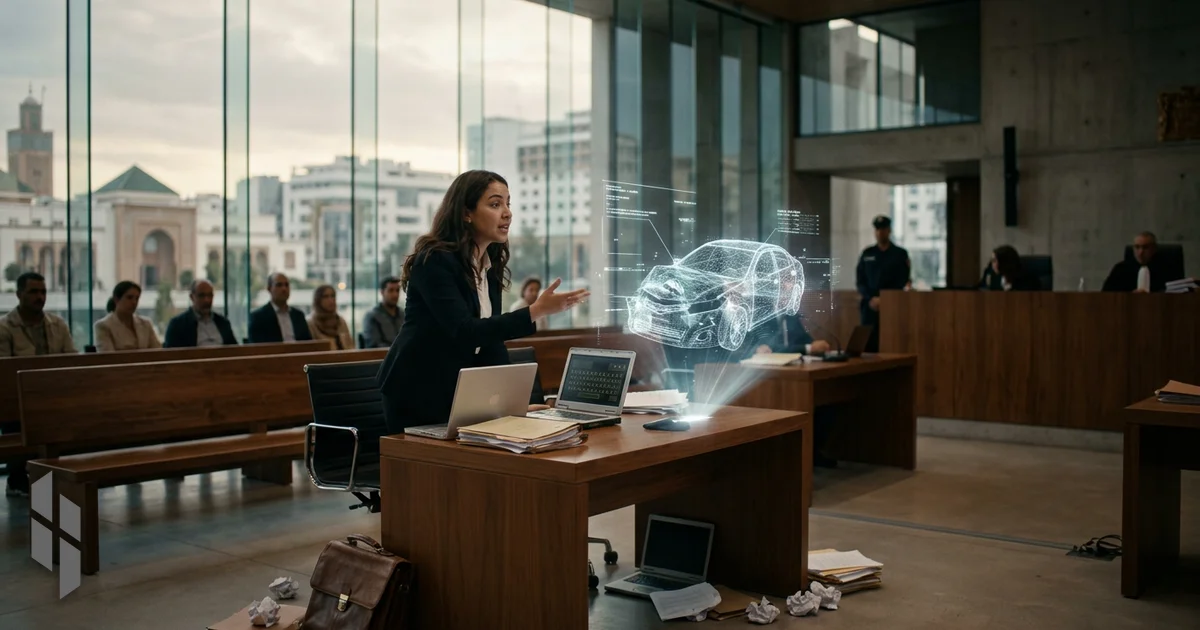
Imagine a scenario in a commercial court in Casablanca in 2026. A business owner presents a video recording of a verbal agreement, only for the opposing counsel to claim the video is a high-fidelity "deepfake" generated by artificial intelligence. Conversely, a prosecutor introduces an AI-driven forensic analysis that identifies a suspect's gait from grainy CCTV footage with 99% accuracy. These are no longer scenes from science fiction; they are the emerging realities of the Moroccan judicial landscape.
As we navigate through 2026, the question of whether AI-generated content or AI-processed data is admissible as court evidence has become the most pressing issue for legal practitioners, businesses, and citizens alike. The rapid evolution of "Legal Tech" in the Kingdom, fueled by the Maroc Digital 2030 strategy, has pushed the boundaries of traditional evidence law.
In this comprehensive guide, you will learn how Moroccan law treats AI evidence, the specific articles of the Code of Obligations and Contracts (D.O.C.) that govern digital proof, and the procedural hurdles one must overcome to use AI-related evidence in a Moroccan court. We will explore the intersection of technology and justice, providing you with the authoritative knowledge needed to navigate a legal system that is increasingly becoming "code-based." Whether you are a lawyer preparing for a trial or a business leader concerned about digital liability, this article serves as the definitive roadmap for AI evidence admissibility in Morocco.
Legal Foundation: The Pillars of Digital and AI Evidence
The admissibility of AI in Moroccan courts is not governed by a single "AI Law" but rather by a sophisticated web of existing codes and new digital-first legislations. To understand if AI evidence is admissible, we must look at the hierarchy of Moroccan legal texts.
The Code of Obligations and Contracts (D.O.C.)
The primary foundation for any evidence in civil and commercial matters is the Dahir of August 12, 1913, commonly known as the Code of Obligations and Contracts (D.O.C.). Specifically, Article 417-1 (introduced via Law 53-05) is the cornerstone of digital evidence. It states that an electronic document has the same probative value as a paper document, provided that the person from whom it emanates can be identified and that it is established and stored in conditions that guarantee its integrity. In 2026, this article is interpreted to include AI-generated logs and digital footprints.
Law No. 43-20: The Digital Transformation of the Judiciary
Law No. 43-20, which amended the Code of Civil Procedure, is the engine behind the modernization of Moroccan courts. It provides the legal basis for the "electronic judicial file" and electronic notifications. This law is critical because it establishes the infrastructure through which AI evidence—such as automated data exports or algorithmic reports—is submitted to the court. You can read more about how this impacts litigation in our guide on judicial digitization impact in 2026.
Law No. 09-08: Data Protection and AI
AI systems rely on data. Law No. 09-08 relating to the protection of individuals with regard to the processing of personal data, overseen by the CNDP (Commission Nationale de contrôle de la protection des Données à caractère Personnel), dictates whether data used by an AI was collected legally. If an AI tool generates evidence using data collected in violation of Law 09-08, that evidence may be declared inadmissible under the principle of "procedural fairness."
The Penal Code and Cybercrime
For criminal matters, the Moroccan Penal Code and Law No. 07-03 (relating to attacks against automated data processing systems) provide the framework for digital forensics. Article 607-3 and following are vital when AI is used to commit fraud or when AI forensics are used to solve crimes. For a deeper dive into the penalties associated with digital misuse, see our cybercrime penalties guide.
Law No. 39.08: The Code of Real Rights
In disputes involving property, Law No. 39.08 (Code of Real Rights), specifically as updated by Law No. 41.24 and Law No. 42.24 in August 2024, governs how rights are recorded. As the Land Registry (Conservation Foncière) integrates AI for title verification, these articles become the standard for challenging or supporting AI-assisted administrative decisions.
Practical Guide: How to Submit AI Evidence in 2026
Submitting AI-generated evidence is more complex than simply printing a report. In 2026, Moroccan judges require a clear "chain of custody" and technical validation.
Step 1: Authentication and Integrity
Under Article 417-2 of the D.O.C., the reliability of a digital system is presumed if the electronic signature is secure. When presenting AI evidence (e.g., an AI-generated contract summary or a predictive maintenance log), you must provide:
- The Metadata: Proof of when and how the data was generated.
- Digital Hash: A cryptographic fingerprint ensuring the data hasn't been altered since the AI generated it.
Step 2: The Role of the Judicial Expert
Moroccan courts rarely rule on technical AI matters without an expert. Under the Code of Civil Procedure, the judge will appoint a "Judicial Expert" specialized in digital systems. The expert’s role is to:
- Verify the algorithm's "black box" (transparency).
- Ensure the AI was not biased or manipulated.
- Confirm that the output matches the input data.
Step 3: Required Documentation
To maximize the chances of admissibility, your legal team should prepare a "Technical Admissibility Folder" containing:
- The AI software license and version details.
- A certification of the data processing environment (often involving Law No. 05-20 on cybersecurity).
- Evidence of compliance with the CNDP guidelines regarding data privacy.
Step 4: Costs and Timelines
While digital courts save on litigation costs, AI evidence can increase technical costs. Expect to pay between 5,000 MAD to 20,000 MAD for a high-level digital forensic expert report, depending on the complexity of the AI system involved. The timeline for expert review typically adds 30 to 60 days to the proceedings.
Key Provisions Explained: Decoding the Law
Understanding the "why" behind the law is essential for any litigant in 2026. Here we break down the most important legal concepts.
The Principle of "Freedom of Evidence" in Commercial Matters
In Moroccan commercial law, governed by the Commercial Code (Law 15-95), evidence is generally "free." Article 334 of the Commercial Code states that commercial matters can be proven by any means. This is the "open door" for AI. If a company uses an AI to manage inventory or execute high-frequency trades, the logs of that AI are admissible as commercial proof, provided they meet the basic integrity requirements of the D.O.C.
The Burden of Proof and AI
In civil law, the burden of proof lies with the plaintiff. However, if you are using an AI system that is proprietary (a "black box"), the court may shift the burden or require "discovery." Article 443 of the D.O.C. (which requires written proof for obligations exceeding 10,000 MAD) has been modernized to accept digital records, but the AI's output must be "readable and understandable" to the judge. An AI report that says "The defendant is liable" without showing the logic will likely be rejected.
Deepfakes and Article 447
Article 447 of the Penal Code criminalizes the distribution of fabricated content without consent. In a 2026 courtroom, if AI evidence is suspected of being a deepfake, the court applies the "Precautionary Principle." The evidence is suspended until a state-certified laboratory (such as the Gendarmerie Royale's digital lab) verifies its authenticity.
AI Liability and Agency
Is the AI a "witness" or a "tool"? Moroccan law currently views AI as a tool. Therefore, the "custodian" of the AI (the person or company running the software) is responsible for its output under Article 88 of the D.O.C., which covers liability for things under one's care. For more on this, see our analysis of AI liability court decisions in Morocco.
Common Mistakes & How to Avoid Them
Even with the best technology, legal errors can render your evidence useless. Here are the pitfalls to avoid in 2026:
- Ignoring Data Privacy (Law 09-08): Many businesses use AI to analyze employee behavior or customer data. If this AI-generated report is brought to court but the data was processed without CNDP authorization, the judge may strike the evidence entirely to protect privacy rights. Always ensure your AI processing is registered with the CNDP.
- Lack of Human Oversight: "The AI said so" is not a legal argument. Moroccan judges value the "Intime Conviction" (personal conviction). Evidence is most effective when presented as "AI-assisted human analysis" rather than "Automated Decision Making."
- Failing to Secure the Source Code: In high-stakes intellectual property or commercial fraud cases, the "logic" of the AI may be questioned. If your company cannot explain how the AI reached a conclusion because the vendor owns the code and refuses to cooperate, the evidence may be deemed "unreliable."
- Incompatibility with Mahakim.ma: All evidence must eventually be uploaded to the mahakim.ma portal. Large AI datasets or proprietary file formats must be converted into court-approved formats (usually searchable PDFs or certified MP4s) or they will be rejected by the system clerk.
Conclusion with Key Takeaways
As we move deeper into 2026, AI is no longer an outlier in Moroccan courts; it is becoming the standard. The Moroccan legal system, through the D.O.C. and Law 43-20, provides a robust—though demanding—framework for the admissibility of AI evidence. Success in the modern courtroom requires a blend of legal expertise and technical precision.
- Integrity is King: Under Article 417-1 of the D.O.C., the integrity of the AI system is the first thing a judge will check.
- Expertise is Mandatory: Expect to involve judicial experts to "translate" AI logic for the bench.
- Privacy is a Prerequisite: Evidence born from illegal data processing (Law 09-08) is "poisoned fruit" and will be inadmissible.
- Digital-First: Use the Mahakim.ma infrastructure correctly to ensure your AI evidence is officially recorded.
Frequently Asked Questions
Yes, AI-generated evidence is admissible as long as it meets the requirements of Article 417-1 of the Code of Obligations and Contracts, which requires proof of the document's integrity and the reliability of the system used to create it.
Moroccan courts treat suspected deepfakes under the Penal Code's provisions against falsification. Judges typically appoint digital forensic experts to verify the authenticity of the media using cryptographic hashes and metadata analysis.
While any registered lawyer can represent you, it is highly recommended to work with a firm specializing in 'Legal Tech' or digital law to ensure that technical evidence is presented in a way that meets the strict standards of Law 43-20.
No. Under current Moroccan law, AI is a tool for assistance. Final judicial decisions must be made by a human judge to ensure the principle of 'Intime Conviction' and the right to a fair trial.
If the data used by the AI was collected without the necessary CNDP declarations required by Law 09-08, the court may declare the evidence inadmissible and you could face fines for data protection violations.
AI evidence must be formatted according to the guidelines of the Mahakim.ma portal. This usually involves converting data into certified PDF reports or standard media formats that are digitally signed.
Get weekly Moroccan legal updates 📬
Exclusive insights on Moroccan law, citizen rights, and new court decisions — delivered straight to your inbox.
No spam. Unsubscribe anytime.
Have More Legal Questions?
Consult 9anon AI now and get accurate, instant answers about your legal situation in seconds.
Related Articles
CNDP Data Processing Authorization 2026
Does your website or app need CNDP authorization? Understand Law 09-08 requirements and practical penalties for non-compliance in 2026.
Data Transfer: When You Need CNDP Authorization (2026)
Hosting client data abroad? Learn when you need prior CNDP authorization for cross-border data transfer in Morocco and avoid fines. A detailed legal guide for 2026.
WhatsApp Admin Liability: Legal Risks in Morocco 2026
Are you a WhatsApp group admin? Discover your legal responsibilities in Morocco in 2026. Avoid liability for content posted by other members.